Profile : David Sol
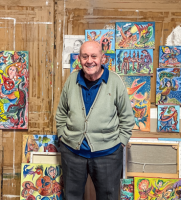
Painter, former ceramic artist, illustrator and art teacher, David Sol has lived and worked in Aigues-Mortes for over sixty years. Inspired by the history of early art, medieval marginalia and Renaissance grotesques, he has gradually created a unique artistic universe of hybrid forms, rhythms and recurring motifs. Here is his story, told through an exceptional interview.
David Sol, the art of a unique imagination
► You are a painter, ceramic artist and illustrator. What was your artistic training ?
Yes, I have produced a number of illustrations, tapestry cartoons and drawings for stained-glass windows. Alongside my work as a ceramic artist and, later, as a painter, I also had another profession : I was an art teacher.
I studied at the School of Fine Arts in Montpellier and, above all, trained at the renowned Sant-Vicens workshop in Perpignan. That is where I truly learned my craft. In 1962, when I completed my military service, I came to settle here. That was the beginning of my story in Aigues-Mortes, which has now lasted for more than sixty years.
► What made you want to study at the School of Fine Arts ? Were you interested in art as a child ?
I belong to a generation when obtaining the BEPC diploma was a major achievement, and it allowed me to enter the School of Fine Arts. Quite simply, I wanted to do what I do today. My father painted beautiful watercolours, which probably influenced me. I have always been passionate about art history, and at school I was considered good at drawing.
► Are you originally from Aigues-Mortes ?
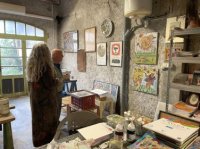
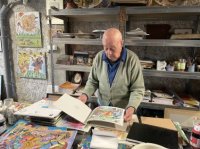
I was born in Lunel in 1937, and my whole family comes from this region. I lost my parents at a young age. They lived and worked in Lunel. I settled in Aigues-Mortes in 1970. My studio is on the ground floor of a former wine cellar, where my ceramic kiln used to stand.
► What has teaching art brought you on a personal level ?
It was never a burden. I taught under ideal conditions in Montpellier, at Saint-François-Régis School, where I felt very happy.
One of my students was Philippe Loubat, now an established painter. He is self-taught, but he still says, "Mr Sol was my only teacher." That's rather nice !
From Ceramics to Painting : Materials and Techniques
► When you were a ceramic artist, did you also make the pieces yourself ?
I mainly focused on the decoration. As a base, I used high-quality Italian or Spanish tiles. A potter made the shapes for me, and I fired the glazes in my kiln. At the School of Fine Arts, I learned some wheel-throwing in the pottery workshop, but it was never my speciality. Above all, I was a painter and decorator.
► Why did you give up ceramics ?
For practical reasons. Ceramics became increasingly difficult : glazes were no longer of the same quality, and some materials were banned. That discouraged me. Then there was the firing itself — you never know exactly what will come out of the kiln. I wanted every piece to be perfect and couldn't accept even the slightest flaw. So many things can go wrong during firing. It was exhausting.
When I retired from teaching in 2000, I devoted myself entirely to paper, especially collage. Since then, I've held around twelve to fifteen exhibitions, on average one every two and a half years.
Working with ceramics is always a leap into the unknown. But when a piece came out of the kiln exactly as I had hoped, it gave me even greater satisfaction than painting.
Inspiration and Artistic Universe
► Is Aigues-Mortes a source of inspiration for you ?
In my repertoire of forms and motifs, there are themes drawn from medieval architecture, birds and vegetation. As I look at this plate in my living room, I notice a tower. It is not exactly like the towers of Aigues-Mortes, but perhaps there is a connection.
► Perhaps your inspiration comes from your surroundings, since you live opposite the ramparts ?
I think space, whether on a canvas or on a ceramic piece, is something important. It is filled with air, and that air is the air of Aigues-Mortes, of that I am certain. I live facing the ramparts, and perhaps all my historical references and my recurring characters come from there. That is what I call my repertoire.
► Have any artists or artistic movements influenced your work ?
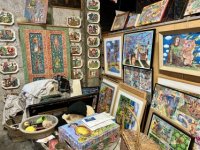
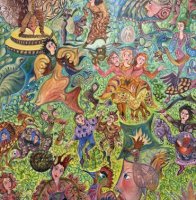
My sources come from early art, from the world of the past and old engravings. The margins of medieval illuminated manuscripts are full of ornaments, characters and fantastic birds. I do not copy them, but they are one of my sources. I also draw inspiration from the modern world, particularly Surrealism, although it belongs to an invented, reinvented world. I often say that my paintings are like a cabinet of curiosities.
► People often mention Picasso, Dalí or Bosch when talking about your work. What do you think of these comparisons ?
Picasso, not really. My work is more rooted in the world of early art, particularly 16th-century painting and Mannerism. Bosch, yes, certainly. But I don't think what I create is Bosch or Dalí. I hope it is, above all, Sol.
The Italian and Flemish painting of the Renaissance has deeply influenced me and helped me evolve. Brueghel as well. What is rather unusual is that I have never directly borrowed a detail or a motif from an old masterpiece.
There is another world that fascinates me : grotesques. These decorative motifs from the Italian Renaissance, and even the Middle Ages, combine foliage, fantastic forms, small figures and animals. This imaginary world is one of my deepest sources of inspiration.
► Do you feel that you have created your own artistic universe ?
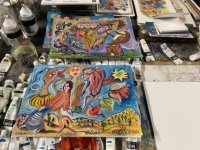
I would say I have absorbed many influences. What comes out is different, but it comes from me. Most of the books you see here are art books—they are my sources. Yet no one can point to a painting and say, "That's Brueghel" or "That's Dalí." People often compare me to Chagall, but I don't feel that connection, even though I admire his work.
I fill sketchbooks with drawings, notes and collages. I work with felt-tip pens, watercolour brushes and whatever comes to hand. There is no hierarchy : some ideas are good, others less so, and sometimes there is nothing at all. But most of my paintings begin there. Then I develop the motif, almost as if I were embroidering it.
There is also a sense of rhythm. When I begin a painting, I first establish an overall direction, then the forms appear naturally : leaf-creatures, animals, flower-animals, heads... That is what I enjoy. The important thing is that the result becomes something truly personal.
Artistic Practice and Reflections on His Work
► Do you tend to work in series or create standalone pieces ?
Definitely in series. The works you've just seen are part of one. If I laid them out from the first one I made three months ago to the latest, I would probably notice an evolution. I don't know if I would call it progress, but by working continuously, you inevitably discover new things.
► How do you react when people interpret your work ?
If someone simply tells me, "It's Chagall," I usually answer with a joke and leave it at that. But I also meet people who say wonderful things about my paintings. Those moments are one of the great pleasures of being an artist.
► How do you see your art evolving in the coming years ?
That's impossible to predict ! It evolves naturally. I never start a painting thinking, "I want this to be completely different from what I did yesterday." It's a continuous process that changes on its own.
Exhibitions, Career and Vision of the Profession
► You have exhibited at the Chapelle des Capucins. What does this place mean to you ?
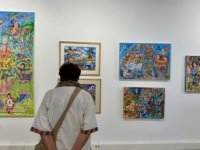
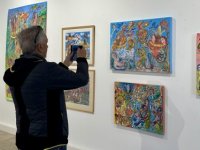
We are fortunate, here in Aigues-Mortes, to have such an exceptional exhibition space as the Chapelle des Capucins. It's much more than a gallery where I can display my work. It is a place of memory, with a certain sense of sacredness, and I believe it enhances the artworks shown there.
► You told us that promoting yourself has never come naturally...
That's true. I've never really known how to sell or promote myself. Creating art is already a full-time job, and combining that with self-promotion has never been my strength.
► Are there projects or moments that have particularly marked your career ?
In the 1970s, I worked with the developers of Port Camargue and La Grande-Motte. I created around fifteen large ceramic panels for the entrance halls of residential buildings, many of which still exist today. In Aigues-Mortes, you can also see my ceramic works on the façade of a bakery on Rue Émile Jamais and in the entrance halls of the Le Tadorne residence along the canal.
What advice would you give to a young artist ?
First, I would say : "You're absolutely right to follow this path." Then I would tell them to work hard, stay curious and never stop learning. Read, listen to music, take an interest in many different things. If you have that creative spark, nurture it and put it into practice.
My friends often say I'm lazy... I always answer that I'm a lazy person who works.
All rights reserved – reproduction, distribution or use prohibited without the prior written permission of the Aigues-Mortes Tourist Office.
Office de tourisme
Aigues-Mortes
Place Saint Louis - BP 23
30220 AIGUES-MORTES