The Camargue traditions
Set off to discover the Camargue and its living traditions.
Learn the Camargue vocabulary used during local festivities and discover the meaning of these words to better understand and experience the spirit of the region. Among horses, bulls and passionate locals, immerse yourself in authentic Camargue life, shaped by its centuries-old customs.
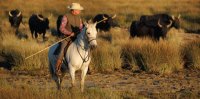
Those involved in Camargue traditions
The manade : traditional livestock farming
A manade refers to a herd of bulls or horses raised in semi-freedom, as well as the farm to which they belong.
Manades shape the landscapes of the Camargue and help preserve local traditions. They are an essential part of the territory’s identity.
The manadier : guardian of the herd
The manadier is the owner and manager of a manade. He oversees the livestock and manages the herd with the help of the gardians.
His work helps preserve large natural areas and traditional Camargue livestock practices.
Discover Camargue traditions up close
To discover the work of the gardians and manadiers, visit a manade. Watch the sorting of the bulls, discover the ferrade and demonstrations of gardian skills, while enjoying a tasting of local products. The experience also continues during a Camargue evening, with a traditional meal featuring gardiane de taureau, before ending the evening to the music of a gypsy band.
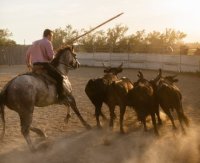
The gardian : the Camargue horseman
The gardian is an iconic figure of the Camargue. Riding a Camargue horse, he looks after herds of bulls and horses raised freely across the territory’s vast natural areas.
His role is essential in managing the herds and passing on Camargue traditions.
The attrapaïres : young people who challenge the bulls
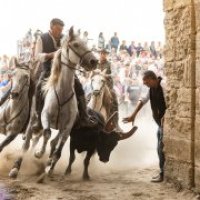
The attrapaïres are participants who try to make the bulls escape during abrivados and bandidos. Positioned along the route, they attempt to disrupt the gardians’ passage in order to isolate a bull and divert it from its path.
This practice requires agility, speed and knowledge of the animals. The attrapaïres represent another facet of Camargue traditions, where challenge and bravery are expressed at the heart of local festivities.
These traditional practices involve risks and require great vigilance.

The Camargue traditions
The abrivado and the bandido : the journey to and from the arenas
The abrivado accompanies the bulls from the pastures to the arenas, passing through the heart of the village. Once the event is over, the bandido marks the return of the bulls to their pastures, following the reverse route, from the arenas to the pastures.
In both cases, the gardians, on horseback, guide the animals and ensure their safe passage. Sometimes, young attrapaïres try to disrupt the herd’s passage, attempting to make the bulls escape as a challenge.
The encierro : the release of the bulls
The encierro is a release of bulls organized along a closed route, on a street or public square closed at both ends by carts and barriers.
Unlike the abrivado or bandido, no horseman guides the animals. The bravest participants provoke the bulls before escaping behind the barriers or onto straw bales.
Local festivals in Aigues-Mortes
In Aigues-Mortes, Camargue traditions are celebrated throughout the year during local festivals, bringing locals and visitors together around the traditions.
Two major events are particularly dedicated to bull-related traditions : the votive festival, held in October, and the winter festival, held in February. Abrivados, bandidos, encierros and other traditional activities bring the town’s streets to life and keep a deeply rooted living heritage alive.
THE gase : crossing the water
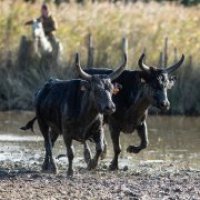
The gase refers to the swimming of bulls across a waterway, accompanied by gardians on horseback.
This tradition recalls the journeys once required between different pastures. The gardians would guide their herds through the many waterways that shape the landscapes of the Camargue.
The Roussataïo : the release of mares
The roussataïo is the release of mares, accompanied by their foals of the year, in the streets of the village.
The term comes from Provençal : “rosso” means mare, while “roussataïo” refers to their movement or transhumance. The animals are accompanied and guided by gardians on horseback.
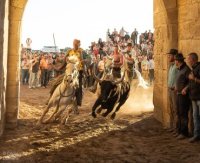
Le Plan : Aigues-Mortes’ temporary arenas
The temporary arenas of Aigues-Mortes consist of wooden stands called “théâtres”. These structures traditionally belong to families from Aigues-Mortes and are assembled each year along the city’s southern rampart.
During the festivities, this unique venue becomes the setting for major bull-related traditions, bringing locals and visitors together for the courses and traditional activities.
AND ALSO…
Discover the Aigues-Mortes votive festival : 12 days of festivities and traditions in October.
Discover the Aigues-Mortes winter festival : a weekend of festivities and traditions in February.
Office de tourisme
Aigues-Mortes
Place Saint Louis - BP 23
30220 AIGUES-MORTES