
The Towers and Ramparts
Discover the Towers and Ramparts of Aigues-Mortes, jewels of medieval heritage.
Explore these unique fortifications, testimonies of royal power and the history of the Crusades. Let yourself be guided along the rampart walk, admire the Tour de Constance, and explore the iconic gates and towers that protected the city for centuries.
An immersive experience between history, architecture and exceptional panoramas, ideal for diving into the soul of Aigues-Mortes and reliving the era of kings and knights.
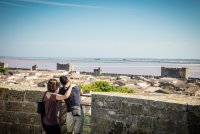
THE GOVERNOR’S LODGE – NEW INTERPRETATION SPACE
To discover the history of the towers and ramparts of Aigues-Mortes, begin your visit at the Governor’s Lodge, recently converted into an interpretation space. Four interactive rooms present the key moments in the history of the city, including :
- The founding of the city by Saint Louis
- The port and maritime trade in the Mediterranean in the 13th century
- The urban development of the city
- The architecture of the fortifications

THE TOWERS AND RAMPARTS OF AIGUES-MORTES – WITNESSES OF THE MIDDLE AGES
With 1,640 metres of fortifications, the ramparts of Aigues-Mortes are among the best preserved in Europe. Initiated by Louis IX to protect the city from enemies and sand-laden winds, the project was continued after his death in 1270 by Philip III the Bold and Philip IV the Fair, and completed at the end of the 13th century or the very beginning of the 14th century.
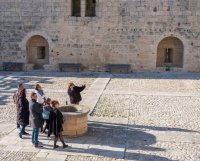
The enclosure, equipped with arrow slits and battlements, was accessible via fifteen military staircases linking the rampart walk to the city, some of which are now walled up.
- South Rampart : Open towards the sea and the ponds, it includes five gates — including the Gates of the Galions, the Marine Gate and the Arsenal Gate — providing access to the port. The Moulins Gate, once topped by two windmills, and the Marine Gate offer panoramic views over the salt marshes. The Galions Gate is distinguished by its sculpted vaults featuring a Minotaur and a monk.
- North Rampart : Focused on defence, it includes two main gates : the Gardette Gate, the main entrance, with its former drawbridge and barbican, and the Saint-Antoine Gate, the secondary entrance. The towers of Sel, Mèche and Villeneuve reinforce the walls and ditches.
- East and West Ramparts : The Queen’s Gate (East) gave access to the Peccais path leading to the royal salt marshes. On the West side, only a small structure, the Remblais Gate, provides access. The Cordeliers Gate, unique in its kind, allowed the Friars Minor to leave towards the surrounding fields.

TOUR DE CONSTANCE – SYMBOLIC MONUMENT OF AIGUES-MORTES
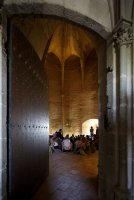
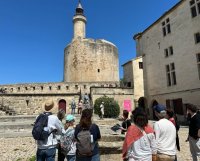
After walking along the rampart walk, do not miss the Tour de Constance, the most emblematic construction of Aigues-Mortes. Take the time to discover its two rooms, its gallery passage and climb up to its terrace to enjoy an exceptional panoramic view.
Built between 1240 and 1248 by Louis IX, this cylindrical tower measures 22 metres in width and 37 metres in height at the top. It has two entrances, to the north towards the countryside and to the south towards the castle. Originally surrounded by a moat crossed by two bridges, it protected the entrance to the royal castle, which was burned in 1421.
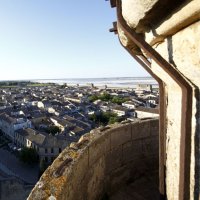
The tower has four levels served by a spiral staircase, and its terrace rises to 26 metres, offering a unique panorama over the city, ramparts, canals, salt marshes, the architecture of La Grande Motte and even the Pic Saint-Loup. The parapet, modified at the end of the 16th century, has four cannon embrasures.
While the first prisoners were Templars, the imprisonment of Protestants for their faith marked its history. The Tour de Constance is therefore a place of memory of French Protestantism, from the Peace of Aigues-Mortes concluded between Francis I and Charles V to the release of the last female prisoners in 1768.
Among them, Marie Durand remains the symbol of resistance : on the rim of the oculus of the upper room, the graffiti “REGISTER” (to resist in Occitan) bears witness to her courage in the face of royal intolerance. Other Huguenot graffiti, often preceded by a capital W, can be seen on the vault of the firing chamber.
The agenda of the Towers and Ramparts of Aigues-Mortes


Office de tourisme
Aigues-Mortes
Place Saint Louis - BP 23
30220 AIGUES-MORTES