Profile : Claude Viallat
After speaking with his grandson, we had the privilege of meeting Claude Viallat, the creator of the magnificent stained-glass windows of Notre-Dame-des-Sablons Church in Aigues-Mortes. A painter, founder of the Supports/Surfaces movement and tireless explorer of colours and materials, he has devoted his life to art. Here is his story, shared through this exceptional conversation.
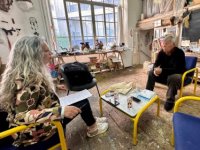
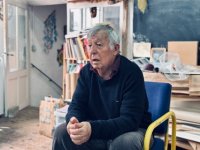
Claude Viallat, the artist behind the church's stained-glass windows
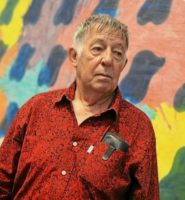
► How did you discover art, and what has your journey been like ?
I studied at the School of Fine Arts in Montpellier. I passed the competitive exam to open a painting studio and was fortunate enough to do so the following year. From the moment I started painting, I knew it was my calling.
► Do you still continue your artistic research ?
Yes, I try to. I have never painted two identical works. I work almost every day, and each of my paintings or objects is different from the others.
► Together with other artists, you explored new materials, leading to the creation of the Supports/Surfaces movement. Was it an exciting adventure ?
It wasn't always enjoyable. At first, no one was interested in our work. Since galleries and museums would not exhibit it, we looked for places where we could show it — mainly outdoors. We worked as much for outdoor spaces as for indoor ones, and the work gradually found its audience.
Inspirations and artistic approach
► Where does your inspiration come from ?
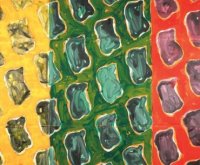
I don't have inspiration — I work. I take one colour and work with it, then another, and then another. I use colour without giving it any symbolic meaning. For me, it is a marker, a value and a material.
► How would you define the shape that has become your "signature" ?
It is actually a fragment of something much larger. I chose a shape that has no particular meaning. It is neither symbolic, nor geometric, nor figurative, nor truly decorative. Each time, it is the surface I work on that transforms the colour, and I accept the way the surface reacts to it.
Everyone sees something different in it. The shape is always changing, but only very slightly. It remains essentially the same, and I never draw it with absolute precision.
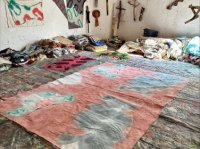
► Do you work with a stencil ?
Yes, always. I use a stencil, whether indoors or outdoors. Sometimes the shape is a little smaller or larger, but it always remains roughly the same size. The material itself changes things. An untreated fabric, for example, absorbs the paint differently, causing the shape to spread or almost disappear. But that's fine with me. It was there at the beginning, and for me it is still there. I accept every unexpected result.
► Do colours also change depending on the surface you work on ?
Absolutely. Whatever fabric I use, the material transforms the colour, and I accept those changes. In the end, I become a spectator of my own work. I never make mistakes because I don't try to force a particular result. I accept whatever the work gives me. In that sense, I cannot be wrong. It is both pretentious and modest.
Aigues-Mortes, the Camargue and the stained-glass windows
► What is your connection with Aigues-Mortes and its heritage ?
The Camargue has always been part of my life and is the landscape where I feel most at home. I naturally gravitate towards the sea rather than the mountains. I spent a great deal of time travelling across the plains between Aubais and Le Grau-du-Roi to attend bull races. Aigues-Mortes has something special : during the local festival, its plan is one of the last traditions still preserved, along with Aubais, the village where I grew up. I am deeply attached to that tradition.
► How did you come to create the stained-glass windows for Notre-Dame-des-Sablons Church ?
It was Bernard Durand, then Deputy for Culture in Nîmes, who contacted me. At first, stained glass did not particularly interest me because I had to work with a master glassmaker. I couldn't create the windows myself, and I don't like delegating.
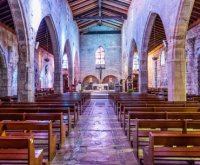
► Had you already worked on projects for religious buildings ?
Yes, in Nevers. I couldn't avoid it because a friend of mine, who was curator at the Centre Pompidou, insisted that I take part. Once I had completed the project in Nevers, I couldn't refuse Aigues-Mortes.
► Did you choose the colours of the stained-glass windows together with the parish priest ?
Not at all. Father Archet was a wonderful man, kind and courteous. He even asked me to create a window representing the Father, the Son and the Holy Spirit. I jokingly replied : the Father in blue, the Son in white and the Holy Spirit in red. In the end, the light itself creates the white.
► Was the history of Aigues-Mortes a challenge for you ?
Yes, in a way. I am Protestant, and Aigues-Mortes holds a difficult place in Protestant history. That was something I had to come to terms with, even though I am married to a Catholic. It wasn't religious differences that troubled me most, but the history of Protestantism. I created one stained-glass window featuring a slightly twisted cross, a symbol that I wanted to be universal.
The stained-glass windows : craftsmanship and technique
► How did you work with the colours of the stained-glass windows ?
I began by working with colour without giving it any symbolic meaning. Glass is the medium through which light passes from outside to inside. The windows had to exist both on the outside and on the inside. Inside the church, it was the architecture that illuminated them. I chose the colours solely according to the tones inside the church, the colour of the stone and the way the stained glass would cast coloured light across the different parts of the building.
► So you chose the colours according to the reflections they would create on the stone in the sunlight ?
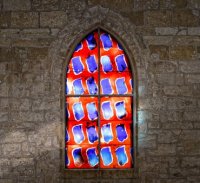
Exactly. What fascinates me about Aigues-Mortes is that, from the outside, the windows are very material, almost like old leather or burnt bread. Inside, they become a harmony of colours. I designed each window separately, distributing the colours from one window to another.
► Did you face any particular technical challenges ?
Not really, because I worked with Master Dhonneur, a master glassmaker and Compagnon du Devoir, an exceptional and highly skilled craftsman. Everything went remarkably well. I wanted to find a way to eliminate the lead, and he introduced me to the triplex technique : three layers of glass placed one on top of another.
The process uses coloured glass coated with a thin coloured varnish. The varnish is removed with acid to reveal the transparent glass beneath.
► What is this coating made of ?
It is a varnish. By removing it, the transparency of the glass reappears. The system uses three layers of glass : if there is blue glass underneath, clear glass in the middle and red glass on top, removing the red reveals pure blue. Removing the blue reveals pure red, and removing both reveals complete transparency.
All the stained-glass windows in Aigues-Mortes were created using this acid-etching technique, which Master Dhonneur developed and adapted for stained glass. It may have existed for other purposes before, but he perfected it for this application. All the windows we created together afterwards were made this way. There is no lead at all.
► Did you reuse elements from the former stained-glass windows ?
We kept the metal crossbars that support the windows. One of the remarkable features of Aigues-Mortes is that the windows are at eye level, making the materiality of the glass particularly striking.
Reception and meaning of the work
► Do you know how local residents and visitors reacted to the stained-glass windows in Notre-Dame-des-Sablons Church ?
At first, the reaction was very negative. But I think people have gradually become used to them, and today they are much better accepted. Whenever I pass through Aigues-Mortes, I always stop to look at them.
► In your opinion, what role does art play in a place of worship ?
I believe it should encourage reflection, contemplation and meditation. It should help people turn inward. Above all, it should bring peace rather than create conflict.
What message would you like to pass on to future generations through your work ?
Peacefulness.
How would you like people to speak about your stained-glass windows in the decades to come ?
I simply hope they will look at them.
All rights reserved – reproduction, distribution or use prohibited without the prior written permission of the Aigues-Mortes Tourist Office.
Office de tourisme
Aigues-Mortes
Place Saint Louis - BP 23
30220 AIGUES-MORTES