
The history of Aigues-Mortes
Discover the fascinating history of Aigues-Mortes, a medieval town in the heart of the Camargue.
Born from the marshes and shaped by the will of Saint Louis, it successively became a port for the Crusades, a fortified stronghold, a Huguenot stronghold and a prison for Protestants.
From its intact ramparts to its imposing towers, along with its saltworks and living traditions, Aigues-Mortes still embodies a unique heritage where royal grandeur, religious struggles and popular memory intertwine.
From its origins to the “dead waters”
Occupied since Antiquity by the Greeks and Romans, the site of Aigues-Mortes was already a salt production centre. Pottery, coins and archaeological remains bear witness to this.
In the 5th century, Benedictine monks founded Psalmody Abbey among the lagoons. A place of prayer and work, it lived from fishing and salt production. But Saracen invasions and debts weakened the community, which eventually gave up its lands in the 13th century.
It was during this period that the name Aquae Mortuae (“dead waters”) appeared to describe these stagnant expanses.

The will of Saint Louis
In 1240, Louis IX, the future Saint Louis, negotiated the acquisition of the territory from the Benedictines. The king, who did not yet have any Mediterranean port, saw this as a unique opportunity to open his kingdom to the sea and the Crusades.
From 1241, construction work began :
- layout of the streets,
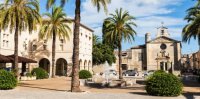
- construction of the Church of Notre-Dame des Sablons,
- construction of the Constance Tower (1239–1250), intended to protect pilgrims and merchants.
As the marshy soil had no stone, it was brought by boat from Beaucaire and Les Baux.
The privileges of 1246
As the marshes were unhealthy, Saint Louis granted a charter of privileges in 1246 to attract inhabitants :
- exemption from taxes and duties,
- commercial monopolies,
- political advantages.
Families from all over France, as well as from Italy, settled there.
Aigues-Mortes and the Crusades
In 1248, Saint Louis left Aigues-Mortes for the Seventh Crusade. The crusaders boarded huissier ships, large two-deck vessels that were heavy and uncomfortable. Crowding, disease and rats were part of the journey, which sometimes lasted three months.
In 1270, the king set sail again for the Eighth Crusade, but died of typhus in Tunis.
The fortified enclosure
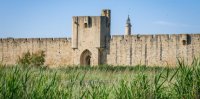
In 1266, Saint Louis planned the construction of the ramparts of Aigues-Mortes, funded by a tax on goods passing through the port. However, his death in 1270 brought the project to a halt before it was completed.
His son, Philip III the Bold, resumed the work in 1272, with the support of the Genoese financier William Boccanegra. He provided funding and expertise to build the Tour Carbonnière, the town walls and the port. After his death, construction slowed again, leaving some works partially unfinished.
In 1285, Philip IV the Fair ordered the ramparts to be resumed and completed. Twenty years after the town was founded, Aigues-Mortes was enclosed by a perfectly designed quadrangular fortified wall, punctuated by monumental gates and defensive towers.
The Constance Tower and Marie Durand
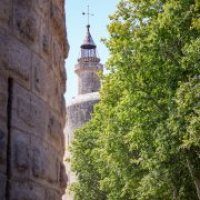
The Constance Tower, initially a fortress, became a prison for Protestants in the 17th century, after the revocation of the Edict of Nantes.
Marie Durand was imprisoned there for 38 years for her faith. She is said to have engraved “RESIST” on a stone, which became a symbol of courage.
The decline of the port and unrest
From the 14th century onwards, silting and the gradual clogging of the waterways slowly led to the decline of the port, which was faced with competition from Marseille.
The following centuries were marked by wars :
- 15th century : betrayal by Governor Malpuë, massacre of the Burgundians.
- 16th century : Protestant raids in 1575, followed by Aigues-Mortes becoming a Huguenot stronghold, retaken in 1622 by Louis XIII.
- 17th century : repression of the Huguenots, with the towers used as prisons.

The French Revolution and the 19th century
The Revolution profoundly changed the town and transformed its religious buildings :
- the Church of Notre-Dame des Sablons became a barracks,
- the Chapel of the White Penitents served as the headquarters of the sans-culottes,
- the Chapel of the Grey Penitents was converted into a fodder store.
At the beginning of the 19th century, the buildings were gradually returned to religious worship or bought back by private individuals. The town gradually regained its vitality, adapting to economic changes and the new needs of trade and industry.
- 1806 : opening of the Rhône–Sète Canal, connecting Aigues-Mortes to major trade routes and facilitating the transport of goods.
- 1842 : severe flooding affected the town, highlighting the vulnerability of the alluvial territory.
- 1856 : creation of the Compagnie des Salins du Midi, which permanently organized and structured salt production, a major resource of the region.
- 1870–1895 : growth of Vin des Sables, whose vines planted in sandy soils escaped phylloxera and contributed to the viticultural reputation of Aigues-Mortes.
The Aigues-Mortes Massacre (1893)
In August 1893, the town was the scene of a tragic massacre targeting Italian workers employed in the saltworks.
Around 50 people were killed and 150 injured, according to estimates, highlighting the violence of anti-Italian racism at the time.
Tensions between French and Italian workers, worsened by difficult working conditions, escalated into a violent manhunt. The intervention of the authorities brought the tragedy to an end, but the event remains a dark chapter in the social and migration history of Aigues-Mortes.
From the 20th century to the present day
In 1903, the ramparts were listed as a Historic Monument. Tourism began to grow with the introduction of paid holidays in 1936.
The Church of Notre-Dame des Sablons was restored and adorned with contemporary stained-glass windows by Claude Viallat in 1991.
Today, Aigues-Mortes remains a lively town : a major historic site and a gateway to the Camargue, where bull-related traditions, saltworks and vineyards preserve a unique heritage. Its ramparts, among the best-preserved in Europe, stand majestically amid the Camargue marshes, recalling the town’s strategic role and rich past.
Between salt production, sandy-soil vineyards, Camargue customs and medieval architecture, the town continues to bring together history and everyday local life.
History at the heart of the present
Aigues-Mortes is not only a testimony to the past : it is a place where history, culture and local life come together every day.
Protecting its ramparts, churches, saltworks and traditions means ensuring that future generations can discover the richness of its medieval heritage, the uniqueness of its Camargue landscapes and the soul of a town that has endured through the centuries.
By respecting this unique place, everyone contributes to keeping the history and identity of Aigues-Mortes alive.
AND ALSO…
The protestantism in Aigues-Mortes
Discover the history of protestantism in Aigues-Mortes : Huguenot stronghold, persecution...

Discover the Towers and Ramparts : Constance Tower, rampart walk, panoramic views...
Office de tourisme
Aigues-Mortes
Place Saint Louis - BP 23
30220 AIGUES-MORTES