
The Camargue flora
Discover the iconic flora of the Camargue, shaped by water, salt and the seasons.
From reed beds to sansouires, and from rice fields to saltworks, the Camargue is home to vegetation adapted to very different natural environments. Some plants tolerate salt water, while others thrive in wetlands or agricultural areas, contributing to the richness of the landscapes and ecosystems.
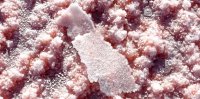
Camargue salt
Salt production in Aigues-Mortes dates back to Antiquity and now covers around 8,000 hectares of saltworks. Thanks to the circulation of seawater and the action of the sun and wind, the water gradually evaporates, allowing the salt to crystallize through a natural process.
The harvested salt is mainly used for food and comes in different forms : salt, coarse salt and the famous fleur de sel, a fine layer of crystals that forms on the surface of the water and is carefully harvested using ancestral know-how.
The saltworks also offer a spectacular landscape, where the water can take on pink or red hues due to the microalgae Dunaliella salina and small shrimp, which are notably a food source for pink flamingos.
These environments are home to flora adapted to high salt concentrations, known as halophilic flora, as well as a wide variety of animal species. The saltworks are therefore a remarkable example of coexistence between human activity, landscape and biodiversity.
Discover salt harvesting
From July to October, discover the harvesting of fleur de sel, salt and coarse salt during guided tours of the Salin d’Aigues-Mortes, accompanied by a salt worker or a nature guide.
A unique opportunity to observe the harvesting process, understand the different stages of salt production and discover the landscapes of the saltworks, as well as the expertise associated with this emblematic activity of the Camargue.
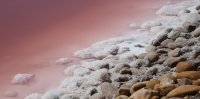
Salt in all its forms
► Fleur de sel forms as fine crystals on the surface of the water. Carefully hand-harvested by salt workers, it is known for its fine, light crystals.
► Salt consists of crystals formed by the evaporation of seawater in the salt ponds. It is harvested when the right concentration and crystallization conditions are reached.
► Coarse salt forms at the bottom of the salt pans, where crystals accumulate during harvesting. Larger and denser, it is widely used in cooking.
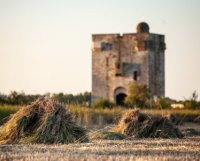
The sagne
The sagne, also known as Sagno, is an iconic reed of the Camargue. It grows abundantly in areas known as Sagniero, particularly around the Étang de Vaccarès and near the Tour Carbonnière, a remarkable feature of the Camargue landscape.
It is harvested in December, when the stems have dried. The sagnié, the person who harvests it, then cuts the reeds and ties them into bundles called manoun. These bundles have been used for centuries in traditional construction : roofs of gardian huts, shelters for horses (laupio), fences and various agricultural structures.
Today, reed beds are home to a wide variety of birds and play an essential role in the functioning of wetlands. Sagne therefore represents both a natural and cultural heritage of the Camargue.
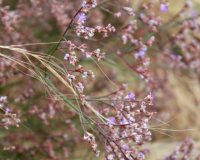
The sea lavender
Known as the gardians’ flower, sea lavender is a typical plant of the sansouires, the salt plains characteristic of the Camargue. In summer, it produces its violet flowers, adding a touch of colour to the landscapes.
Particularly well adapted to salty soils, it can withstand difficult conditions thanks to its ability to accumulate and tolerate salt. Its stem is sometimes covered with a fine white layer of salt.
It also contributes to the richness of saline natural environments and provides a habitat for many small insects, particularly during flowering.
Traditionally used in dried bouquets, sea lavender is also part of the cultural identity of the territory. Its presence reflects the ability of Camargue flora to adapt to the particular conditions of these environments.
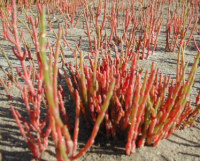
THE Glasswort
Glasswort is an iconic plant of the Camargue’s saline environments. It grows in sansouires and along lagoons, on soils where few plants can survive. Its fleshy stems allow it to store water and withstand high concentrations of salt.
Green in spring, it gradually takes on red and orange hues in autumn, adding colour to the Camargue landscapes. Adapted to extreme conditions, this plant contributes to the richness and diversity of the halophilic flora characteristic of the territory.
Some glasswort species are also used in cooking, particularly as a condiment, thanks to their naturally salty flavour.
THE Camargue rice
Rice farming was developed in the Camargue to help desalt the land and make the soil suitable for cultivation. After several periods of development and decline, it now plays an important role in the Camargue’s agricultural landscape.
Rice fields require careful water management and, depending on the season, provide a habitat for many animal and plant species. They therefore contribute to the diversity of habitats in the Camargue and reflect the close relationship between agriculture and the environment.
Different varieties are grown, including white rice, red rice and black rice, each with its own characteristics and culinary uses. Protected by a Protected Geographical Indication (PGI) since 2000, Camargue rice is now one of the territory’s emblematic products.
Local speciality
Camargue rice is also used in many traditional Camargue dishes, served as an accompaniment to meat, fish and other local produce.
It is notably used to prepare gardiane de taureau, a traditional dish made with Camargue bull meat and one of the emblematic specialities of Camargue cuisine.
AND ALSO…
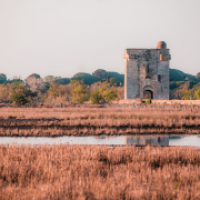
Discover the classified natural areas : Natura 2000 network, Grand Site de France...
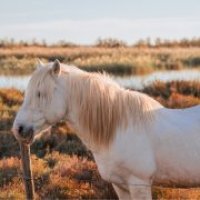
Discover the wildlife of the Camargue : pink flamingos, horses and bulls...
Office de tourisme
Aigues-Mortes
Place Saint Louis - BP 23
30220 AIGUES-MORTES